
Picture this: It’s 7:30 AM at a biotech company in Cambridge. Sarah, the VP of Operations, is already on her third cup of coffee, frantically jumping between a vendor crisis, two direct reports who need “urgent” decisions, and a board presentation due by noon. Her calendar shows back-to-back meetings until 6 PM, her inbox has 147 unread emails, and she hasn’t had a meaningful development conversation with her team in weeks.
Sound familiar? That’s not surprising, since Sarah is part of a staggering statistic that should keep every CHRO and business leader awake at night: 75% of HR leaders believe their managers are overwhelmed (Gartner HR Priorities Survey 2025). Even more alarming? That same Gartner survey found that 70% report their current leadership programs aren’t preparing managers for today’s reality.
We’re not talking about a simple productivity hiccup here. This is a financial crisis hiding in plain sight. Poor management costs U.S. companies up to $360 billion annually in turnover, productivity loss, and disengagement (Hoops HR, 2024). In New England’s competitive landscape, where life sciences turnover exceeds 20% and the war for talent is fiercer than ever, overwhelmed managers aren’t just struggling. They’re actively driving away the very people your organization desperately needs to retain.
But here’s the thing: while most companies are watching their managers drown, smart organizations are throwing them lifelines. They’re not just surviving the leadership crisis. They’re building teams that actually thrive when the pressure’s on.
THE SCOPE OF THE CRISES: BY THE NUMBERS
The Burn Out Epidemic is Real
When three-quarters of HR leaders admit their managers are drowning, we’re not talking about isolated incidents or temporary stress. This is happening everywhere, across every industry.
Here’s what’s really happening with manager time allocation, and it’s not pretty. The average manager spends over one-third of their day in meetings, about 30% of which could have been skipped (the kind where you wonder “this could have been an email”) (Otter.ai Report, 2022). Managers also report dedicating 25% to administrative tasks that could easily be automated or delegated (GetMoreDone, 2020).
More shocking? A Harvard Business Review survey of managers found that, while HR leaders expect managers to spend about 36% of their time on coaching and team development, managers actually average only 9% of their time developing talent (HBR, 2018).
How Managers Report Spending Their Time
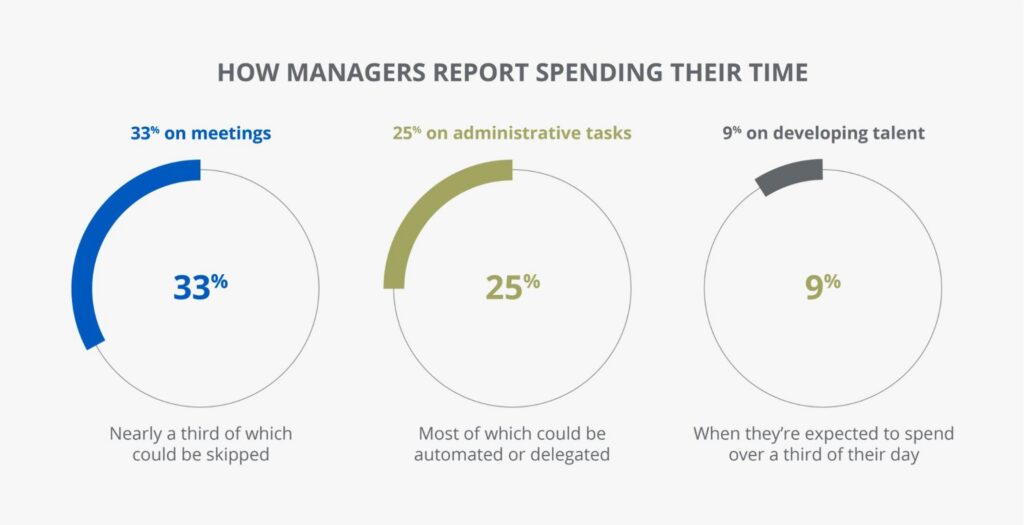
This backwards time allocation explains why 70% of current leadership programs fail to prepare managers for today’s reality (Gartner HR Priorities Survey 2025). We’re essentially training leaders for yesterday’s challenges while today’s demands pile up like dirty laundry.
New England Feels the Pain Acutely
The manager crisis hits particularly hard in New England’s knowledge-intensive industries. Consider the troubling reality facing our region: life sciences and biotech companies in Massachusetts are experiencing turnover rates exceeding 20%, with voluntary resignations accounting for a staggering 95% of separations. Translation? People aren’t being laid off — they’re choosing to leave. Meanwhile, hospital systems across the region report turnover rates of 20.7%, putting patient care directly at risk (MCPHS.edu, 2025).
Turnover in healthcare isn’t just costly. It’s destabilizing. Erin Beloin, Director of Program Management at MCPHS/Massachusetts, captures the regional reality perfectly: “Healthcare and life sciences are incredibly valuable fields, but they can also be highly demanding and intensive. Anything we can do to move the needle to improve employee satisfaction and retention over time will ultimately make a significant impact on an organization.” (MCPHS, 2025)
In the tech industry, the numbers are particularly brutal, with leadership roles experiencing turnover rates of around 60%, resulting in constant disruption to product development cycles (Insignia Resources, 2025). That’s basically flipping a coin to see if your manager will still be there next year.
The situation becomes even more challenging when you look at the span of control. Manager-to-employee ratios vary wildly across industries, with healthcare typically requiring lower ratios of around 1:8-10 while service industries such as retail can function effectively at 1:15-20. However, changes in industry needs, organizational maturity, and workforce composition characteristics can greatly shift these ratios (Shyft, 2025). Without proper training on how to manage these new and different scales of responsibility, it’d be like asking someone to conduct a string quartet one day and a full orchestra the next, without any experience or training.
The True Cost of Drowning Leaders
The financial impact of poor management creates a cascade of costly consequences that most organizations severely underestimate. Here’s the stark reality: 75% of voluntary turnover stems directly from managerial issues, while replacing just one employee due to poor management costs between 30% to 200% of their annual salary (Hoops, 2024). When you factor in that teams with poor managers show 20% lower productivity and 23% lower profitability (Marketplace, 2024), the numbers become staggering.
Perhaps most concerning is that employee disengagement affects 50% of the workforce, with 70% of engagement variance tied directly to manager quality (Awardco, 2024). This means that in most organizations, half the team is mentally checked out, primarily because of their direct supervisor. Imagine paying full price for a workforce where half the people are basically running on autopilot.
Let’s make this concrete with a typical New England biotech company employing 200 people at an average salary of $85,000. Poor management practices could trigger 40 preventable departures annually, with replacement costs ranging from $1.02 million to $6.8 million. Add productivity losses exceeding $340,000 from disengaged remaining staff, plus innovation delays that could cost millions in missed market opportunities, and you’re looking at a crisis that hits balance sheets across Massachusetts, New Hampshire, and beyond every single quarter.
WHY TRADITIONAL LEADERSHIP IS FAILING
Measuring the Wrong Things
Most organizations pour money into leadership development programs and then scratch their heads, wondering why their managers still seem lost. The answer is surprisingly simple: they’re measuring all the wrong stuff.
Mark Murphy, a leading leadership expert, cuts straight to the heart of the issue: “Leadership development often fails because we’ve been measuring the wrong things. Completion rates and facilitator ratings don’t indicate behavior change. Training department success metrics don’t correlate with employee experience or the development of effective leaders.” (Forbes, 2025) Instead, real impact needs to come from behavior change and daily leadership routines.
Think about your organization’s last leadership program. Did you measure how happy participants were with the catered lunch and how many people showed up? Or did you track whether managers actually started having better conversations with their teams, whether turnover dropped, and whether people stopped running for the exits whenever their boss walked by?
The disconnect is mind-boggling. While 92% of respondents say leaders who are good role models are important to a good company culture, and 89% recognize strong people-management skills as essential for company success (BDO, March 2025), most development programs focus on teaching theories instead of changing daily habits. It’s like teaching someone to be a great driver by showing them engine diagrams instead of putting them behind the wheel.
The Cognitive Load Crisis
Here’s what traditional leadership development completely misses: the human brain has limits. Modern managers face what neuroscience researchers call “chronic cognitive overload,” and no amount of training can overcome a brain that’s constantly in crisis mode.
The research reveals some eye-opening truths about how cognitive overload creates manager overwhelm. Multitasking reduces performance by up to 40% while increasing errors by up to 20%, and constant interruptions prevent the deep thinking required for strategic leadership (LinkedIn 2025). Prolonged exposure to high cognitive workload can also lead to decision fatigue that leads to questionable choices later in the day (like approving that really bad marketing campaign at 4 PM) and impair our ability to regulate stress (iMotions, 2025).
Chronic stress impairs memory, creativity, and emotional regulation and leads to eventual burnout, manifesting as emotional exhaustion, reduced motivation, and decreased performance. In other words, when your brain is maxed out, you have a recipe for leadership breakdown where everything falls apart.
Yet most leadership programs pile on more information, more frameworks, and more “best practices” without addressing the fundamental issue: managers’ brains are already running at 110% capacity. Remember our Cambridge biotech VP, Sarah, from earlier? She’s processing 147 emails while juggling 6-8 meetings with minimal breaks, handling 12-15 “urgent” requests from various stakeholders, making 3-5 strategic decisions requiring deep analysis, and managing multiple crises demanding immediate attention. And then we wonder why the leadership seminar on “Strategic Thinking in the Digital Age” didn’t stick.
No wonder 75% of HR leaders feel their managers are overwhelmed by their responsibilities (Gartner HR Priorities Survey 2025). We’re asking human brains to operate like supercomputers while providing training designed for a world where people actually had time to think.
The smartest organizations are waking up to this reality and implementing “cognitive wellness” programs that include dedicated deep work blocks free from interruptions, visual workload management tools to prevent overcommitment, mental recovery breaks built into the workday structure, and decision-making frameworks that reduce cognitive burden (LinkedIn, 2025). Until we address the cognitive load crisis, even the best leadership development programs will fail to create sustainable change.
THE RIPPLE EFFECT: WHAT HAPPENS WHEN MANAGERS DROWN
The Turnover Tsunami
When managers are overwhelmed, their teams don’t just notice — they pack their bags and head for the exit. The connection between manager effectiveness and employee retention isn’t subtle; it’s about as direct as a fire alarm at 3 AM.
Gallup’s research spells out the harsh reality. Teams with poor managers experience 50% higher turnover than those with effective leaders, while productivity drops by 20% and profitability falls by 23% under struggling managers (Marketplace, 2024). Perhaps most telling, it’s reported that managers are responsible for 70% of the variance in team engagement, making them the deciding factor in whether employees are engaged and effective, or disengaged and likely to quit (Gallup, 2020).
In New England’s competitive talent market, these numbers can translate into immediate competitive disadvantage. Picture what happens when a single overwhelmed manager leads a team of eight professionals in a Massachusetts biotech company. In year one, you’ll likely see 2-4 team members leave (probably your best performers, because they have options), with replacement costs ranging from $85,000 to $340,000 based on average regional salaries. The remaining team members become overworked, increasing their likelihood of joining the exodus, while projects face delays as new hires require 3-6 months to reach full productivity.
By year two, the situation spirals further out of control. Reputation damage makes future recruiting more difficult (word travels fast in tight-knit industries), institutional knowledge walks out the door, creating inefficiencies and errors, team morale tanks as survivors wonder if they’re next, and manager stress increases exponentially, creating a vicious cycle that’s incredibly difficult to break.
Team Performance Plummets
The performance impact goes way beyond turnover statistics. When managers drown, their teams sink with them, creating drops in every metric that matters.
Regional case studies from Massachusetts hospitals show this cascade in action. In a State of Massachusetts Nursing Survey, 78% of nurses say that understaffing has decreased the quality of care to the point where 40% said they would not feel safe admitting a family member (Massachusetts Nursing Association, 2025). Medical errors increase when nursing leadership lacks bandwidth for proper oversight, and staff engagement surveys consistently show a decline under overwhelmed management. In healthcare, this isn’t just about numbers — people’s lives are literally at stake.
In the biotech sector, overwhelmed managers create different but equally costly problems. Research timelines stretch like taffy when managers can’t provide adequate project guidance, cross-functional collaboration breaks down as managers retreat into survival mode, innovation suffers when teams lack leadership support for creative problem-solving, and regulatory compliance issues emerge when oversight becomes inconsistent. In an industry where being first to market can mean billions in revenue, these delays are devastating.
Here’s the thing: teams are like mirrors — they reflect their manager’s state right back. Overwhelmed managers create overwhelmed teams. Stressed managers spread stress like a contagious yawn. Disorganized managers foster chaos that would make a toddler’s playroom look neat.
Thankfully, the same ripple effect does work in reverse. When organizations invest in manager effectiveness, the positive impact cascades throughout the entire team structure, creating real improvements in engagement, productivity, and retention. It’s like taking the time and money to regularly change the oil in your car; it’s the most effective way to ensure that your entire engine performs at its best.
THE LIFELINE: WHAT ACTUALLY WORKS
Continuous Development Over One-Time Training
The organizations successfully rescuing their drowning managers have figured out something important: leadership development isn’t a weekend seminar you attend once and magically become a great leader.
It’s like learning to play piano — you don’t become Beethoven after one lesson.
The return on investment tells the story. Each dollar invested in effective leadership development returns an average of $7, with some programs achieving returns as high as $11 for every dollar spent (New Level Work, 2025). More importantly, 35% of organizations report direct revenue increases from strong leadership initiatives (Harvard Business Review, 2022), while 86% see positive ROI from coaching programs (iPEC Coaching, 2022). Not bad for something that’s supposedly “soft skills.”
What separates successful programs from expensive failures? Four key principles emerge from the most effective approaches:
- Behavior-focused rather than knowledge-focused development enables you to teach your leaders what to do, not just what to think about
- Continuous micro-learning instead of intensive workshops allows your team to process bite-sized chunks, not fire hoses of information
- Real-world application with immediate feedback loops provides your managers the chance to practice with actual problems, not just role-play scenarios
- Personalized development paths based on individual manager challenges, because one-size-fits-all doesn’t really fit anyone
The Microsoft Model: Model, Coach, Care
Microsoft’s transformation of manager effectiveness offers a blueprint that works across industries. Their “Model, Coach, Care” framework restructures leadership expectations to deliver improvements in leadership trust and team empowerment. The best part is that it’s refreshingly simple to understand.
The approach is elegantly straightforward:
- Model. Managers demonstrate the behaviors they expect (it’s a radical concept: actually practicing what you preach)
- Coach. This is to shift from directive management to developmental coaching (which means spending time growing team members instead of micromanaging them)
- Care. Show genuine investment in individual success, both professionally and personally (because people aren’t robots, despite what some executives seem to think)
This approach completely flipped the traditional management pyramid. Instead of managers as taskmasters cracking the whip, they became enablers of team success. The results? Real improvements in employee engagement, retention, and performance across Microsoft’s global operations (Microsoft, 2022). Who knew treating people well would work so effectively?
New England Success Stories
Local organizations are proving that effective manager development creates real advantages in our region’s talent-intensive markets.
UroGen Biotech’s Transformation stands out as a particularly compelling example. Working with WLH Consulting, this biotech company created a 12-month “Aspiring Leaders Program” that went far beyond death-by-PowerPoint training (WLH, June 2024). The program featured interactive mentorship with senior executives, monthly leadership summits focusing on real business challenges, capstone projects with real business impact, and ongoing peer coaching circles.
The outcome? Improved alignment between leadership behavior and business results, with real improvements in team engagement and project delivery timelines. Turns out investing in managers actually pays off — who could have predicted that?
IIDA New England’s Leadership Pipeline has produced graduates who chair committees and ascend to board leadership positions (IIDA NE). But the real success lies in what participants report: enhanced confidence in handling complex team dynamics, improved time management and priority-setting skills, stronger networks for ongoing professional support, and real business impact through better team performance. It’s like a leadership finishing school, but actually useful.
Perhaps most encouraging are the results from Massachusetts hospital systems implementing action-based leadership programs. A team from MassGeneral Hospital for Children participated in the Institute for Healthcare Improvement’s “Joy in Work” action-learning case to find ways to better engage with staff (IHI, 2021).
Specific leader actions that promote engagement (such as timely 1:1 check-ins) raise first-year retention by 6–13 percentage points (AONL, 2025), and facilities with high engagement scores have RN turnover 5.6 percentage points lower than those with the lowest engagement (Press Garney, 2023). In healthcare, where staff turnover can literally impact patient outcomes, approaches that help to reinforce daily leadership habits over pure theoretical frameworks can be life-changing.
Boston Consulting Group’s Embedded Approach
Boston Consulting Group’s “design for adoption” methodology provides another proven model that addresses the cognitive load crisis we discussed earlier (BCG, 2025). Rather than traditional training (where everyone pretends to pay attention while checking email), their model embeds coaches directly into daily operations.
Their focus areas make perfect sense: putting leadership habits into practice tied to specific business outcomes, creating feedback loops that reinforce positive behaviors, building internal capability so improvements don’t disappear when consultants leave, and tracking behavioral change rather than training satisfaction. This embedded approach provides support exactly when and where managers need it most, recognizing that overwhelmed brains can’t absorb theoretical knowledge but can adopt practical tools in the moment they’re needed.
Technology as Support, Not Solution
Progressive organizations are getting smart about technology — they’re using it to reduce administrative burden rather than replace human judgment. AI-powered tools are helping managers by automating routine scheduling and administrative tasks, providing data-driven insights for performance conversations, tracking team engagement trends in real-time, and suggesting personalized development resources based on individual challenges (Korn Ferry, 2025).
The key insight here is crucial: technology amplifies good management practices but cannot substitute for them. The most effective approaches combine human-centered development with technological efficiency, using AI to free up cognitive bandwidth for the strategic thinking and relationship building that only humans can provide. Robots can schedule meetings, but they can’t inspire teams to greatness.
YOUR ACTION PLAN: BUILDING MANAGER RESILIENCE
Step 1: Assess Current Manager Cognitive Load
Before you can rescue drowning managers, you need to figure out exactly where they’re struggling. Spoiler alert: traditional performance reviews won’t cut it. They’re about as useful for identifying cognitive overload as asking someone if they’re tired while they’re falling asleep standing up.
Start with a thorough time audit where managers track their actual time allocation for two weeks, categorizing activities as strategic, administrative, coaching, or reactive. Fair warning: the results might be depressing. Simultaneously, map interruption frequencies by counting daily interruptions and their sources to identify cognitive load patterns. You’ll also want to track decision fatigue by monitoring the number and complexity of decisions managers make daily, while using simple 1-10 energy ratings throughout the day to identify when cognitive drain kicks in.
The red flags that scream cognitive overload are pretty telling. Look for red flags such as:
- Less than 20% of time spent on strategic thinking and team development (because who has time for that when there are fires to put out)
- More than 15 interruptions per day from various sources
- Energy scores consistently drop below 6 by mid-afternoon
- Steady increases in response times to non-urgent communications
Step 2: Implement Continuous Learning Systems
Replace those traditional training events with ongoing development that actually fits into managers’ real workflows. The most effective approaches focus on micro-learning and peer support rather than intensive workshops that make people want to hide under their desks.
Consider implementing a micro-learning framework with 15-minute weekly modules focused on specific management challenges. Think bite-sized learning, not all-you-can-eat buffets that leave everyone feeling stuffed and slightly nauseous. Research shows that 83% of employees complete a 10-minute microlearning module compared to only 20-30% of traditional instructional courses (eLearning Industry, 2025). Pair this with peer coaching circles meeting monthly to discuss real workplace scenarios, action learning projects where managers apply new skills to current business challenges, and digital coaching prompts delivered through existing communication tools.
The most successful implementations share common elements: shared learning experiences in cohorts that reduce isolation and create accountability (because misery loves company, but so does success), ongoing peer coaching that provides real-time support during challenging situations, targeted upskilling through microlearning that prevents cognitive overload while building capabilities, and dedicated support for manager mental health and cognitive bandwidth management.
Step 3: Create Support Networks
Isolated managers are like plants without water — they eventually wither and die (professionally speaking). Building organized support networks provides the scaffolding managers need to handle increased complexity without drowning in it.
Your internal support architecture should include manager mentorship programs pairing experienced leaders with developing managers (think wisdom sharing, not hazing rituals), cross-functional peer groups where managers from different departments share challenges and solutions, executive coaching accessibility for high-stakes situations requiring specialized support, and mental health resources specifically designed for leadership stress and cognitive wellness.
Don’t overlook external support options either. Industry peer networks like IIDA New England’s leadership program provide valuable regional connections, while professional coaching relationships focused on leadership effectiveness rather than general career development can provide a crucial outside perspective. Leadership development partnerships with local higher educational institutions and research organizations can offer custom-tailored programs that use regional expertise. There is a wealth of options available in the Boston area alone. Sometimes the best insights come from people who don’t drink your company’s Kool-Aid.
Step 4: Measure What Matters
Stop measuring training satisfaction and start tracking behavioral change. Seriously, nobody cares if people enjoyed the continental breakfast at your leadership retreat. The most successful organizations focus on leading indicators that predict manager effectiveness rather than lagging indicators that only confirm problems after they’ve already caused damage.
Your leading indicators should include manager time allocation shifts toward coaching and strategic work, team engagement scores in regular pulse surveys, response time improvements to team member requests for guidance, and proactive versus reactive decision ratios based on manager self-reporting.
Focus on these behavioral change metrics:
- Frequency of one-on-one meetings with direct reports (because management by walking around only works if you actually stop and talk)
- Quality of development conversations as rated through team feedback
- Manager stress levels tracked through cognitive wellness assessments
- Team performance improvements in productivity and innovation metrics
For business impact measurements, track reduction in manager-related turnover compared to baseline periods, improved team performance metrics, including project delivery and quality measures, enhanced cross-functional collaboration scores from internal surveys, and ROI calculations showing the financial impact of manager development investments.
Putting It All Together
The key to a successful program is clear alignment between business goals and leadership behaviors, with systems for implementing ongoing real-world feedback and development. True, sustainable change will take between 6-12 months to fully embed. You’re essentially training for a marathon, not a sprint. Measure progress monthly, but evaluate success annually to account for the natural learning curve and behavioral change timeline.
Organizations that implement all four steps of the action plan to improve manager effectiveness will see real improvements in team performance within the first quarter, and then increase over time. It’s like compound interest, but for leadership skills.
THE NEW ENGLAND ADVANTAGE: BUILDING TOMORROW’S LEADERS TODAY
New England’s knowledge economy creates unique opportunities for organizations willing to invest in manager effectiveness. While other regions are still figuring out the basics of leadership, forward-thinking companies in Massachusetts and New Hampshire are building advantages through superior management capabilities. It’s like having a head start in a race where everyone else is still tying their shoes.
The regional landscape offers distinct benefits that smart organizations are using to their advantage. Our concentration of world-class educational institutions provides access to modern management research and methodologies that simply aren’t available elsewhere (try finding MIT-level insights in most places). The dense network of innovative companies creates great opportunities for cross-industry learning and best practice sharing — your biotech manager can learn from your neighbor’s SaaS executive over coffee in Harvard Square. Meanwhile, our high-stakes business environment means that effective leadership directly translates to market advantage in ways that are immediately visible.
Perhaps most importantly, New England’s sophisticated talent pool expects and responds to excellent management. This creates a virtuous cycle where good managers attract great talent, which in turn enables even better management practices. It’s like a leadership snowball effect, but in the best possible way.
Companies that master manager effectiveness in this environment become talent magnets that attract the region’s best professionals while competitors struggle with turnover and disengagement. The emerging leadership competencies that separate winners from losers include adaptability, digital fluency, empathy, collaboration, and authentic leadership. Organizations building these capabilities now will dominate their markets as competition for talent intensifies.
But here’s the challenge that keeps many leaders awake at night: developing these managers internally takes 12-18 months minimum. That’s longer than most people keep their New Year’s resolutions. Smart organizations are recognizing that the fastest path to management excellence isn’t always developing from within. Sometimes it’s smart hiring of proven leadership talent who can immediately impact team performance and culture. Finding and hiring the proven leaders who already possess these skills requires a completely different approach.
SKIP THE 6-MONTH SEARCH — WE’LL DELIVER MANAGER-READY LEADERS IN WEEKS
Don’t let manager overwhelm torpedo your Q4 goals. While your competitors spend months posting jobs, screening hundreds of resumes, and hoping the right management talent will magically appear (spoiler: they won’t), you could be solving your leadership crisis in a fraction of the time.
The Nagler Group specializes in finding proven human resource, administrative, and legal leaders who have the skills and experience to transform teams. Our 16 years in New England’s market mean we know exactly which managers thrive in biotech pressure cookers, which leaders excel in SaaS scaling challenges, and which executives can navigate healthcare’s complex demands without breaking a sweat.
Why struggle with overwhelmed managers when you can have effective ones? We provide access to the top 1% of leadership talent before competitors even know they’re available, deliver blazingly-fast placements without compromising quality or cultural fit (because nobody wants a great resume attached to a terrible personality), offer contract, contract-to-hire, and direct hire options to match your exact needs, and bring deep New England market knowledge across biotech, SaaS, healthcare, and professional services.
Ready to stop the manager crisis before it stops you? Contact The Nagler Group today and discover how quickly effective leadership can transform your teams from surviving to thriving.
Visit us at www.naglergroup.com or connect with me on LinkedIn to start the conversation.
